Here we will dive into the key factors you must consider when choosing a water purifier.Don't let your wallet take a hit without getting the healthy water you deserve!
Should you buy a water purifier? Does a higher price tag or more features automatically mean better performance? Truth is, there are plenty of pitfalls to avoid. Today, we'll dive into the key factors you must consider when shopping for a water purifier. Don't let your wallet take a hit without getting the healthy water you deserve!
Let's be honest: the market is flooded with flashy models that can make your head spin. Some claim to filter out 99.999% of bacteria, others emphasize mineral retention, and some even cost tens of thousands of yuan per unit... But here's the thing—not every expensive machine suits your needs. In fact, some high-priced products aren't as practical as niche brands costing just a few hundred yuan! So how should we make the right choice? Keep reading as I break it down based on my own experience.
First, you need to understand the “core parameters” that truly matter for water purifiers. These directly determine whether it can safeguard your drinking water safety. The four most common yet easily overlooked factors are:
1. Filter Cartridge Types and StagesHave you noticed that while they're all called “water purifiers,” some are bulky and large while others are compact and sleek? The main difference lies in the filter cartridges. Common types include PP cotton, activated carbon, ultrafiltration membranes, and RO reverse osmosis—each serves a distinct purpose!
• PP cotton traps large particles like sediment and rust;
• Activated carbon adsorbs odors and colors while removing residual chlorine;
• Ultrafiltration membranes further eliminate bacteria and impurities but struggle with dissolved solids;
• RO reverse osmosis delivers true deep purification, even tackling heavy metals.
Generally, more filtration stages indicate finer purification. However, a 7-stage system isn't necessarily superior to a 5-stage one—it all depends on the materials used in each stage. If all stages use cheap materials, the overall performance might be less reliable than a well-designed 3- or 4-stage combination. When choosing, first check the main filter cartridge configuration. If unsure, ask customer service directly: “What type are the main filter cartridges?”

2. Rated Water Output & Flow RateMany discover a major pain point after installing a water purifier—water flows at a snail's pace, taking forever to fill a pitcher. This is because different models have varying rated water output and flow rate designs. If your household has many members or high kitchen water usage, prioritize products labeled “high flow rate.” Otherwise, you'll question your life choices daily. Another common misconception is that RO purification is always best. However, RO membranes require high water pressure from the tap. If your home's water pressure is insufficient, you'll need an external booster pump; otherwise, you won't get much purified water. Before purchasing, clarify the flow rate (L/min) and daily capacity (L/d). For household use, we recommend selecting high-flow models rated at ≥400 gallons per day.
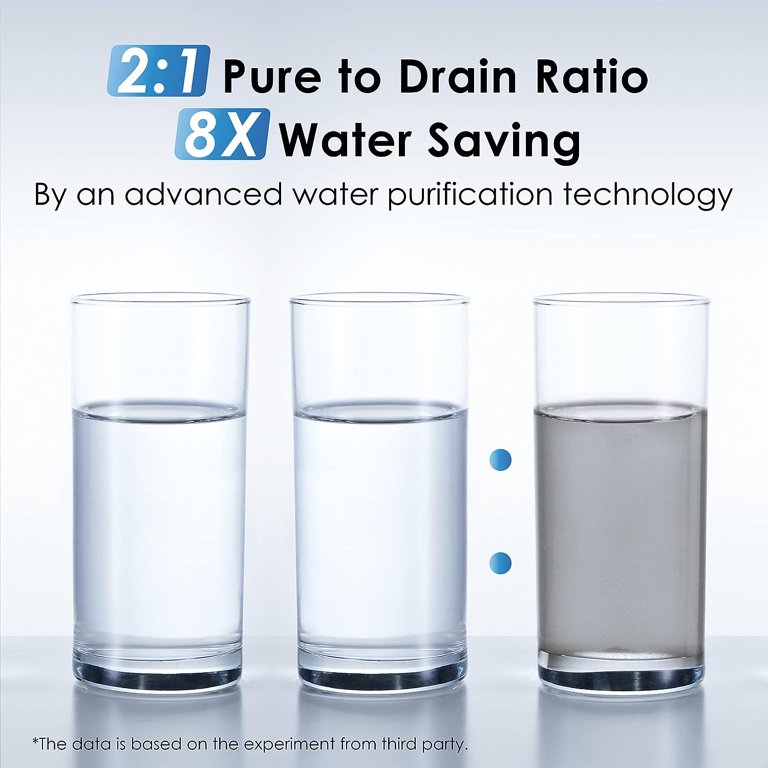 3. Water-to-Waste Ratio
This term might sound technical, but it simply refers to how much waste concentrate water is produced for every liter of purified drinking water. Some older RO units can flood your kitchen drain like a downpour within an hour. Newer water-saving models typically achieve a 1:1 ratio or lower, while outdated models may exceed 1:4. This means for every cup of pure water you drink, you're discarding four cups of waste. Not only is this wasteful, but it's also painful for the environment and your wallet! Opt for newer products with a “low waste ratio” or those explicitly featuring water-saving balance technology—it's both eco-friendly and cost-effective.
4. Maintenance Costs & After-Sales ServiceMany shoppers fixate on the price tag while overlooking long-term filter replacement costs. A cheap machine requiring expensive filters every three months ends up far pricier than a slightly more expensive, reputable brand that only needs replacement annually. Plus, major brands offer robust after-sales support—small manufacturers often leave you stranded with no repairs, leaving you feeling helpless. So don't just fixate on the upfront cost—think about your maintenance budget! Before buying, ask the manufacturer how often each filter needs replacing and the cost per replacement. Opt for major brands with nationwide warranties or city-wide service networks.
Feeling like a semi-expert now? Truth is, most salespeople won't volunteer this info. But remember this—core specifications always trump flashy ads, and you won't fall for tricks so easily! One last tip: Tap water pollution varies greatly by region. If possible, bring a sample of your home's tap water for testing. Check heavy metals, residual chlorine, and microbial levels to decide whether you need deep RO filtration or if standard ultrafiltration suffices. After all, what suits you best is truly the best choice~ If you still have questions after reading this, feel free to leave a comment. I'll help analyze which model best fits your needs~ If you found this guide helpful, bookmark it and share it with friends and family to help them avoid pitfalls too!