Explanation of water treatment terms and basic pure water treatment processes,common pure water treatment processes,various uses of pure water, Q&A on key points,difficulties in pure water treatment.
I. Glossary1. Raw water: Refers to untreated natural water or city tap water, also known as raw water.
2. Clarified water: Water from which suspended impurities have been removed.
3. Demineralized water: Water from which the cations and anions have been essentially removed or reduced to a certain level. Demineralization methods include distillation, electrodialysis, reverse osmosis, and ion exchange.
4. Turbidity: Refers to the degree of turbidity in water. It is an optical effect caused by the presence of suspended matter (including colloids) in water. The unit is NTU. Turbidity is one of the main visual indicators of water pollution. The standard unit of turbidity is 1 degree of turbidity per 1 mg of SiO2.
5. Flocculant: An agent that causes colloid particles to form coagulation bridges, resulting in flocculation.
6. Total alkalinity: Refers to the total amount of substances in water that can neutralize strong acids.
7. Acidity: This refers to the total amount of substances in water that can neutralize strong bases.
8. Hardness: This refers to the amount of metal ions in water that tend to form precipitates, typically calcium and magnesium ions.
9. Conductivity: This is the electrical conductivity of a solution measured between two parallel electrodes with a cross-sectional area of 1 square centimeter and a distance of 1 centimeter at a given temperature. It indirectly indicates the amount of dissolved salts in the water.
10. Resistivity: This is also an indicator of water's electrical conductivity. The greater the resistivity, the poorer the conductivity and the fewer ions it contains. Its commonly used unit is MΩ.cm. It has an inverse relationship to conductivity. For example, if the conductivity of water is 0.2 μS/cm, its resistivity is 1/0.2 = 5 (MΩ.cm).
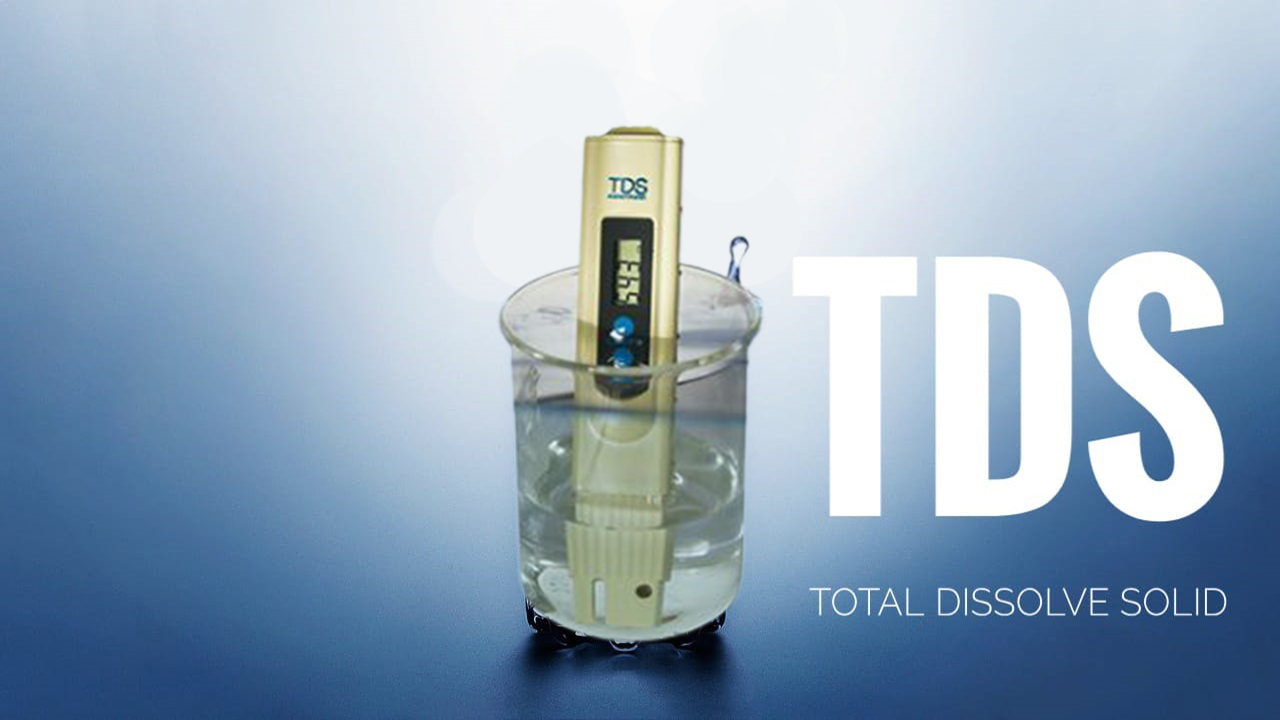
11. TDS (Total Dissolved Solids): This is the inorganic matter remaining after filtering out suspended solids (SS) and colloids and evaporating all water. It is measured in ppm or mg/l and can be measured using a TDS meter. It also reflects the ion content in water. A rough correspondence between pH and conductivity is: for a sodium chloride reference solution, a TDS value of 1 ppm corresponds to a conductivity of 2 μs/cm.
12. pH: The relative amounts of acid and base in a solution. pH is measured as the negative logarithm (log) of the hydrogen ion concentration in water. The pH scale ranges from 0 to 14, with a pH of 7.0 indicating neutral water; a pH less than 7.0 indicating acidic water; and a pH greater than 7.0 indicating alkaline water.
13. Alkalinity: Alkalinity refers to the amount of substances in water that can accept [H+] ions and react with strong acids. Substances that contribute to alkalinity in water primarily include carbonate alkalinity (from carbonates), bicarbonate alkalinity (from bicarbonates), and hydroxide alkalinity (from the presence of hydroxides).
14. SDI: Soil contamination index—a measure of the amount of suspended solids in the raw water used in reverse osmosis systems.
15. Ozone: An unstable, highly reactive form of oxygen, produced by natural lightning or high-voltage electrical charges passing through the air. It is an excellent oxidant and disinfectant.
16. Residual Chlorine: The amount of available chlorine remaining in water after a certain period of contact with chlorine.
17. Total Escherichia coli: Total coliform bacteria refers to a group of aerobic and facultatively anaerobic, Gram-negative, non-spore-forming bacteria that, when grown at 37°C, ferment lactose and produce acid and gas within 24 hours. Total coliform bacteria refers to the number of total coliform bacteria per liter of water sample.
18. Recovery Rate: The ratio of the system's product water flow rate to the inlet water flow rate.
19. Salt Rejection Rate: A parameter reflecting membrane performance. A primary RO membrane system typically has a salt rejection rate above 97%. This can be calculated simply as: (raw water conductivity - product water conductivity) / raw water conductivity.
20. Salt content: The salt content of water, also known as mineralization, indicates the amount of salts in the water. Since salts in water generally exist in the form of ions, salt content can also be expressed as the sum of the amounts of various cations and anions in the water.
21. Sedimentation: One of the technical methods for wastewater treatment. It can be divided into physical and chemical precipitation. The most commonly referred to precipitation is physical precipitation, which is a method of gravity separation.
22. Reclaimed water: This term has various meanings. It is called reclaimed water in wastewater engineering and recycled water in industrial plants. It is generally distinguished by water quality. It primarily refers to non-potable water that has been treated to meet certain quality standards and can be reused within a certain range. The quality of reclaimed water lies between that of raw water (drinking water) and that of sewage (domestic sewage), which is why it is called reclaimed water. Systems that supply reclaimed water are also called reclaimed water systems.
23. Organic pollution: This term refers to natural organic matter in the form of carbohydrates, proteins, amino acids, fats, and other biodegradable, synthetic organic matter. Mainly from domestic sewage and industrial wastewater.
24. Concentration Polarization: During reverse osmosis operation, salts are concentrated on the membrane surface, creating a concentration difference between the salts in the influent and the influent. If the concentrate flow rate is low and the flow velocity is low, the high-salt water cannot be removed promptly, resulting in a large concentration difference on the membrane surface, hindering the diffusion of salts. This phenomenon is called concentration polarization.
25. Suspended Solids (SS): refers to solid matter suspended in water, including insoluble inorganic and organic matter, as well as silt, clay, and microorganisms. The suspended solids content in water is one of the indicators of water pollution. It is the amount of solids obtained by drying the retained material on the filter paper after filtering the water sample at 103-105°C. The unit is mg/l.
26. Aeration: The process by which oxygen (O2) in the air is transferred to the mixed solution for utilization by microorganisms. Its purpose is to provide dissolved oxygen required by microorganisms such as activated sludge, ensuring the oxygen demand for microbial metabolic processes.
27. Biochemical Oxygen Demand (BOD): This refers to the amount of dissolved oxygen consumed by microorganisms during the decomposition and oxidation of organic matter in water under specified conditions, at specified temperatures, and for a typical period of five days at 20°C. This is abbreviated as BOD5 and is expressed in mg/L.
28. Chemical Oxygen Demand (COD): This refers to the amount of oxygen consumed by strong oxidants to oxidize organic matter in wastewater under certain conditions. Wastewater testing standards generally use potassium dichromate as the oxidant. This value is expressed in mg/L.
29. Pure Water: This refers to water from which both easily removable strong dielectrics and difficult-to-remove weak electrolytes such as silica and carbon dioxide have been removed to a certain degree. Pure water has a salt content below 1.0 mg/L and a conductivity less than 3 μs/cm.
30. Ultrapure Water: Also known as high-purity water, this refers to water from which the conductive dielectric has been virtually completely removed and in which non-dissociated colloids, gases, and organic matter have been removed to very low levels. Ultrapure water has a salt content below 0.1 mg/L and a conductivity less than 0.1 μs/cm.
31. Water yield (flux): This refers to the capacity of a reverse osmosis system, that is, the amount of water passing through the membrane per unit time, usually expressed in tons per hour (t/h) or gallons per day (g/d).
32. EDI: Short for continuous electrodialysis, it is a new ultrapure water production technology that cleverly combines electrodialysis and ion exchange.
II. Basic Processes in Pure Water Treatment
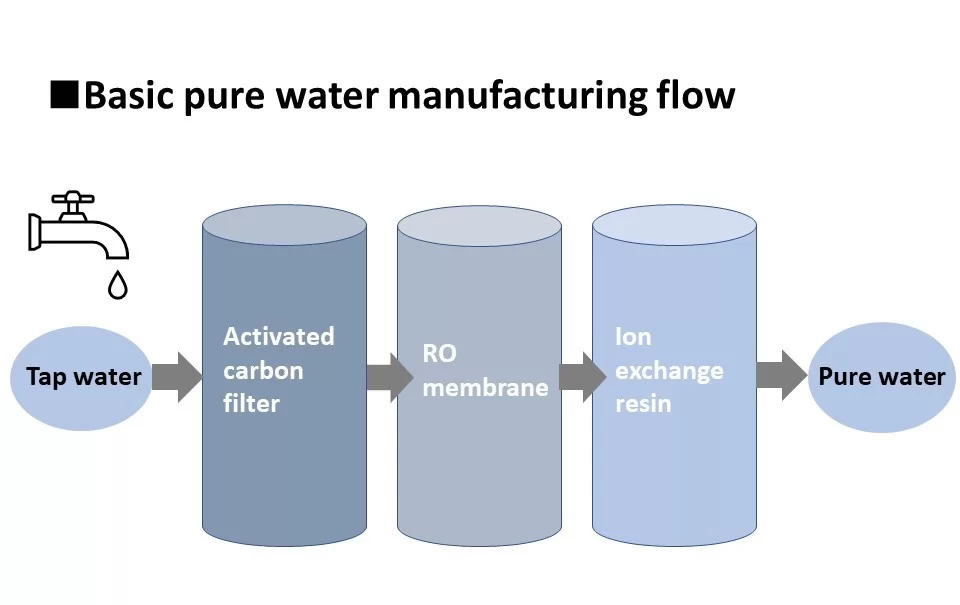
1. Coarse filtration: This refers to mechanical filtration that removes suspended matter, colloids, turbidity, color, and odor from water. Major filtration methods include clarifiers, rapid filters, sand filters, sand filters, multi-media filters, activated carbon filters, disc filters, and high-efficiency fiber filters.
2. Fine filtration: This uses filter membranes made of special materials to achieve high filtration accuracy. Common filtration methods include microfiltration membranes and cartridge filters. 3. Ultrafiltration: This is a membrane filtration method that removes large molecules, colloids, bacteria, and other substances. It has high filtration precision, and ultrafiltration membranes are the most common.
4. Reverse Osmosis: Reverse osmosis, abbreviated as RO, works by passing raw water through a reverse osmosis membrane under high pressure. The solvent in the water diffuses from high concentration to low concentration, achieving separation, purification, and concentration, as it is the opposite of the natural osmosis direction.
5. Ion Exchange: Various inorganic salts in water ionize to form cations and anions. When passing through the hydrogen-type ion exchange layer, the cations are replaced by hydrogen ions (this is the desalination principle of a cation bed). When passing through the OH-type ion exchange layer, the anions are replaced by OH- ions (this is the desalination principle of an anion bed). A mixed bed is an ion exchange device in which cation and anion exchange resins are mixed and packed in a single exchange column in a specific ratio.
6. EDI: It is a new desalination process that combines electrodialysis and ion exchange. It takes the advantages of electrodialysis and mixed bed ion exchange, uses ion exchange for deep treatment, does not require chemical regeneration, and uses ionization to generate H+ and OH- to achieve the purpose of regenerating resin.
III. Common Water Treatment ProcessesRaw water for groundwater: Sand filter + microfiltration filter + reverse osmosis + mixed bed or EDI
Raw water for tap water: Sand filter + activated carbon filter + microfiltration filter + RO + mixed bed or EDI
Surface water:
① Multi-media filter + activated carbon filter + microfiltration filter + RO + mixed bed or EDI
② Multi-media filter (or other filter type) + ultrafiltration + microfiltration filter + RO + mixed bed or EDI
③ Disc filter + ultrafiltration + microfiltration filter + RO + mixed bed or EDI
IV. Various Uses of Pure Water1. Pure and ultrapure water are widely used in power plants, electronics, pharmaceuticals, and chemical industries. Harmful ions are removed from the water through filtration or ion exchange using various membranes.
2. Desalted water, commonly used in power plants, has the following key water quality indicators: hardness approximately equal to zero, conductivity ≤ 0.2 μs.cm, and SiO2 ≤ 20 ppb.
3. Chemical plants use a wide variety of water. While water quality requirements are generally no higher than those for power plants, they may have specific ion requirements. Therefore, single-stage or double-stage reverse osmosis processes are often used. The effluent conductivity should be at least 5-10 μs.cm. Higher requirements require a mixed bed or EDI process.
4. Pharmaceutical water often has specific requirements for conductivity and bacteria, placing strict demands on system materials, with stainless steel often used. Purified water typically requires sterilization and disinfection equipment.
5. The electronics industry has the highest water requirements, with most requiring 18 megawatts. Resistivity requirements are only a small fraction of electronic water; they also have high requirements for many ions, placing special demands on installation materials and piping. The process is also the most complex. EDI typically requires a polishing mixed bed, ultrafiltration, sterilization, and nitrogen-sealed water tanks, all of which are expensive.
V. Key Questions and Answers on Difficulties in Pure Water Treatment1. What are the main causes of RO membrane performance degradation?
1) Chemical changes within the membrane: hydrolysis, free chlorine, and oxidative interference from active chlorine.
2) Physical changes within the membrane: Membrane compaction, which decreases water permeability and increases salt removal efficiency; Membrane contamination: Scale, microorganisms, and solid particles on or within the membrane cause contamination and clogging.
2. What is the purpose of adding NaHCO₃ during the desalination process in an RO unit?
It eliminates or reduces the residual chlorine content in the water, ensuring the stability of the RO element.
3. Principle of Activated Carbon Chlorine Removal
Activated carbon removes residual chlorine not through physical adsorption but through a chemical reaction. When free residual chlorine passes through the activated carbon, it catalyzes the surface, rapidly hydrolyzing oxygen atoms (O) and reacting with carbon atoms to produce carbon dioxide. At the same time, HClO in the raw water is rapidly converted to CO₂ gas.
Combined reaction: C + 2Cl₂ + 2H₂O → 4HCl + CO₂↑
Based on the above reaction, the amount of activated carbon in the reaction vessel will gradually decrease depending on the residual chlorine content in the raw water and should be replenished annually.
4. Reverse Osmosis Process Principle: RO removes most of the salt from water by utilizing the properties of a semipermeable membrane (permeable to water but impermeable to salt). Pressurization is applied to the raw water side of the RO process, forcing a portion of the pure raw water to pass through the membrane perpendicularly. Salts and colloids in the water concentrate on the membrane surface, while the remaining raw water, traveling parallel to the membrane, carries away the concentrated substances. The permeate contains only a small amount of salt, which is then collected, achieving desalination.