
The Industrial Water Treatment Equipment Market grew from USD 36.69 billion in 2023 to USD 38.72 billion in 2024. It is expected to continue growing at a CAGR of 5.08%, reaching USD 51.92 billion by 2030.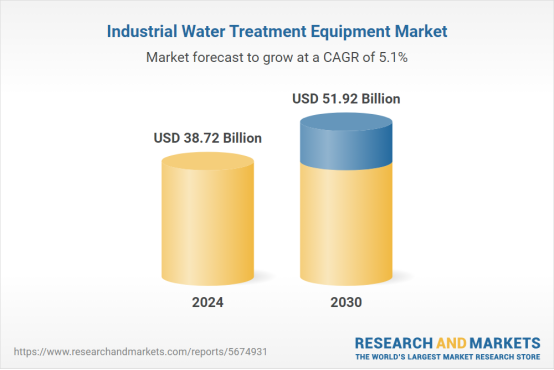
The scope of the industrial water treatment equipment market encompasses a wide range of technologies and processes designed to treat water across various industrial applications. These include filtration, disinfection, desalination, and chemical treatment systems intended to remove contaminants and impurities to cater to the demands of sectors like manufacturing, power generation, and oil & gas. The necessity of these systems arises due to the increasing need for sustainable water management driven by stringent governmental regulations, rising environmental concerns, and the global push towards water reuse and recycling. End-use applicability stretches from industries such as chemical manufacturing, pharmaceuticals, and food & beverages to utilities and mining, which require high-quality water for efficient and hygienic production processes.
Key factors influencing market growth include advancements in technology, rising awareness about the benefits of efficient water management, and favorable regulatory frameworks supporting water conservation and waste reduction. Latest opportunities lie in the development of smart water treatment solutions integrating IoT and AI, which enhance efficiency and reduce operational costs by enabling real-time monitoring and predictive maintenance. To capitalize on these opportunities, companies should focus on innovative solutions that improve treatment efficiency and sustainability while adhering to regulatory standards. However, the industry faces challenges like high capital and operational costs, complex regulatory compliance, and varying policy frameworks across different regions. Additionally, market growth can be hampered by low awareness in emerging markets and resistance to adopt new technologies.
Areas ripe for innovation include the enhancement of energy-efficient treatment systems, the development of cost-effective point-of-use solutions for small and mid-sized industries, and the improvement of membrane technologies for filtration and desalination. Business growth can be driven by strategic partnerships and investments in R&D that focus on sustainable solutions. Understanding the dynamic and competitive nature of the market is crucial for stakeholders aiming to maximize their foothold in the lucrative industrial water treatment equipment sector.
The Industrial Water Treatment Equipment Market is rapidly evolving, shaped by dynamic supply and demand trends. These insights provide companies with actionable intelligence to drive investments, develop strategies, and seize emerging opportunities. A comprehensive understanding of market dynamics also helps organizations mitigate political, geographical, technical, social, and economic risks while offering a clearer view of consumer behavior and its effects on manufacturing costs and purchasing decisions.
Porter’s Five Forces framework further strengthens the insights of the Industrial Water Treatment Equipment Market, delivering a clear and effective methodology for understanding the competitive landscape. This tool enables companies to evaluate their current competitive standing and explore strategic repositioning by assessing businesses’ power dynamics and market positioning. It is also instrumental in determining the profitability of new ventures, helping companies leverage their strengths, address weaknesses, and avoid potential pitfalls.
External macro-environmental factors deeply influence the performance of the Industrial Water Treatment Equipment Market, and the PESTLE analysis provides a comprehensive framework for understanding these influences. By examining Political, Economic, Social, Technological, Legal, and Environmental elements, this analysis offers organizations critical insights into potential opportunities and risks. It also helps businesses anticipate changes in regulations, consumer behavior, and economic trends, enabling them to make informed, forward-looking decisions.
The Industrial Water Treatment Equipment Market share analysis evaluates vendor performance. This analysis provides a clear view of each vendor’s standing in the competitive landscape by comparing key metrics such as revenue, customer base, and other critical factors. Additionally, it highlights market concentration, fragmentation, and trends in consolidation, empowering vendors to make strategic decisions that enhance their market position.
The Industrial Water Treatment Equipment Market FPNV Positioning Matrix is crucial in evaluating vendors based on business strategy and product satisfaction levels. By segmenting vendors into four quadrants - Forefront (F), Pathfinder (P), Niche (N), and Vital (V) - this matrix helps users make well-informed decisions that best align with their unique needs and objectives in the market.
The Industrial Water Treatment Equipment Market strategic analysis is essential for organizations aiming to strengthen their position in the global market. A comprehensive review of resources, capabilities, and performance helps businesses identify opportunities for improvement and growth. This approach empowers companies to navigate challenges in the increasingly competitive landscape, ensuring they capitalize on new opportunities and align with long-term success.
In the context of the process industry, the industrial water treatment equipment market encompasses the various systems and technologies used for treating water so that it meets regulatory standards and becomes suitable for specific industrial applications. Water treatment processes are essential in industries such as power generation, pharmaceuticals, chemical manufacturing, and food and beverage production, where water quality directly impacts the manufacturing process, product quality, and waste management. The equipment used in this market includes filters, clarifiers, evaporators, desalination units, and disinfection systems. Treatment processes are tailored to the particular needs of an industry, with the aim of optimizing water reuse, minimizing waste, and ensuring the longevity and efficiency of industrial equipment. Key factors such as water scarcity, industrial expansion, and environmental regulations drive the adoption of advanced water and wastewater treatment solutions. Some companies that are prominent in the industrial water treatment equipment market include SUEZ Water Technologies & Solutions, Ecolab Inc., Veolia Water Technologies, Aquatech International, Evoqua Water Technologies, and Xylem Inc. These companies offer a range of products and services, from turnkey water treatment systems to individual components and consulting services, catering to the diverse needs of the process industry.


